How Foreigners Can Boost Their Credit Score in Korea (Essential Tips for Loans and Credit Cards)
A must-read guide for managing your credit score while settling in Korea. Learn the 5 key secrets to boosting your score, from checking NICE and KCB records to using debit cards and paying utility bills.
💡 Credit Score Management is Not an Option, It’s a 'Must'
Have you opened a bank account and set up a mobile plan to live stably in Korea? If so, the next thing you must pay attention to is your 'Credit Score'. A high credit score is advantageous not only when applying for credit cards or 'Jeonse' (deposit-based) loans but even when renting a house under good conditions.
However, many people feel overwhelmed because they don't know how to raise their score. "Where can I check my score?", "Will my score go up if I don't have a loan?"
In this guide, we will help you understand Korea's credit evaluation system and introduce 5 core strategies to effectively boost your credit score without borrowing money.
Understanding Korea’s two major credit bureaus (NICE vs. KCB)
Boosting your score with debit cards instead of credit cards
Getting immediate bonus points via utility and mobile bill payments
Fatal factors that decrease your score—avoid these at all costs
Understanding Korea's Credit Evaluation System (NICE & KCB)
Korea has abolished the old 1-10 grade system and currently uses a 1,000-point credit score system (as of 2026).
Main evaluations are conducted by two private credit bureaus, and they weigh different factors differently:
NICE Evaluation Information (Nice Ki-mi): Primarily looks at your 'repayment history'. The key is whether you are paying back debt without overdue payments.
KCB (All Credit): Primarily looks at your 'credit transaction patterns'. It focuses on how healthily you use your credit card (ideally 30-50% of your limit).
Since banks refer to scores from both agencies when reviewing loan or credit card applications, it is important to keep both scores consistently high.
[!TIP]
Checking Your Credit Score for Free
If you have an Alien Registration Card (ARC) and are using an affordable phone plan or carrier plan under your own name, you can check your credit score for free just like local citizens via apps like 'Toss', 'KakaoPay', and 'NaverPay'. Checking your score frequently does not lower it!
🚀 5 Practical Guides to Boosting Foreigner Credit Scores
When you first open a Korean bank account, you may start with a low score because you lack financial transaction history. Build your 'financial trust' steadily with the following 5 methods.
1. Set a Primary Bank and Use Your Debit Card Consistently
If you aren't eligible for a credit card yet, a Debit Card is the answer.
Consistently using a debit card for more than 300,000 KRW per month for at least 6 months is recognized as credit transaction history and grants bonus points.
If you consolidate your salary, living expenses, and utility bill payments into one bank to create a 'primary account', your internal bank credit rating increases, which is advantageous for future loans.
2. Use Only 30–50% of Your Credit Card Limit (Lump-sum Payment)
If you have received a credit card, how you use it determines your score.
Maxing out your credit card limit every month can be a negative factor. It is recommended to use around 30-50% of your limit comfortably.
Lump-sum payments are better for your credit than installments. Be wary of the temptation of interest-free installments, a unique aspect of Korean payment culture.
Developing the habit of pre-paying (paying off the balance 2-3 days before the payment date) is also a great tip.
3. Register 'Faithful Payments' for Phone and Utility Bills (Submit Non-financial Info)
This is the fastest way to gain bonus points. Use the 'Boost Credit Score' feature in apps like Toss, KakaoPay, or the credit bureau apps.
You can submit records of National Pension, Health Insurance, NTS income proof, and mobile phone bill payments with one click.
If you have a record of paying consistently without arrears for over 6 months, you will see an immediate boost in your score. (It is recommended to resubmit every 6 months.)
4. Utilize the Housing Subscription Savings Account
Korea's Housing Subscription Savings is not just for winning an apartment lottery. By making consistent payments over time and submitting this record to the credit bureau (as non-financial information), you gain extra points as it is recognized as a sign of sound asset-building efforts.
5. The Golden Rule: Never be 100,000 KRW or 5 Days Overdue
Overdue payments will instantly ruin all your efforts to raise your credit score.
If you are overdue by more than 5 business days on any payment over 100,000 KRW—be it mobile bills, health insurance, or credit card bills—your credit score will drop significantly.
These short-term delinquency records stay with you like a tag for at least 1-3 years even after you pay them off. Always set up Direct Debit to prevent overdue payments at the source.
🚫 Factors to Avoid (Short-term Card Loans)
Even if you need cash urgently, never use a credit card's 'Cash Advance (Short-term Card Loan)' or 'Card Loan (Long-term Card Loan)'. Not only do these have high interest rates, but credit bureaus interpret this as "this person is currently in a very bad financial situation," which is the primary cause of a sharp drop in your credit score.
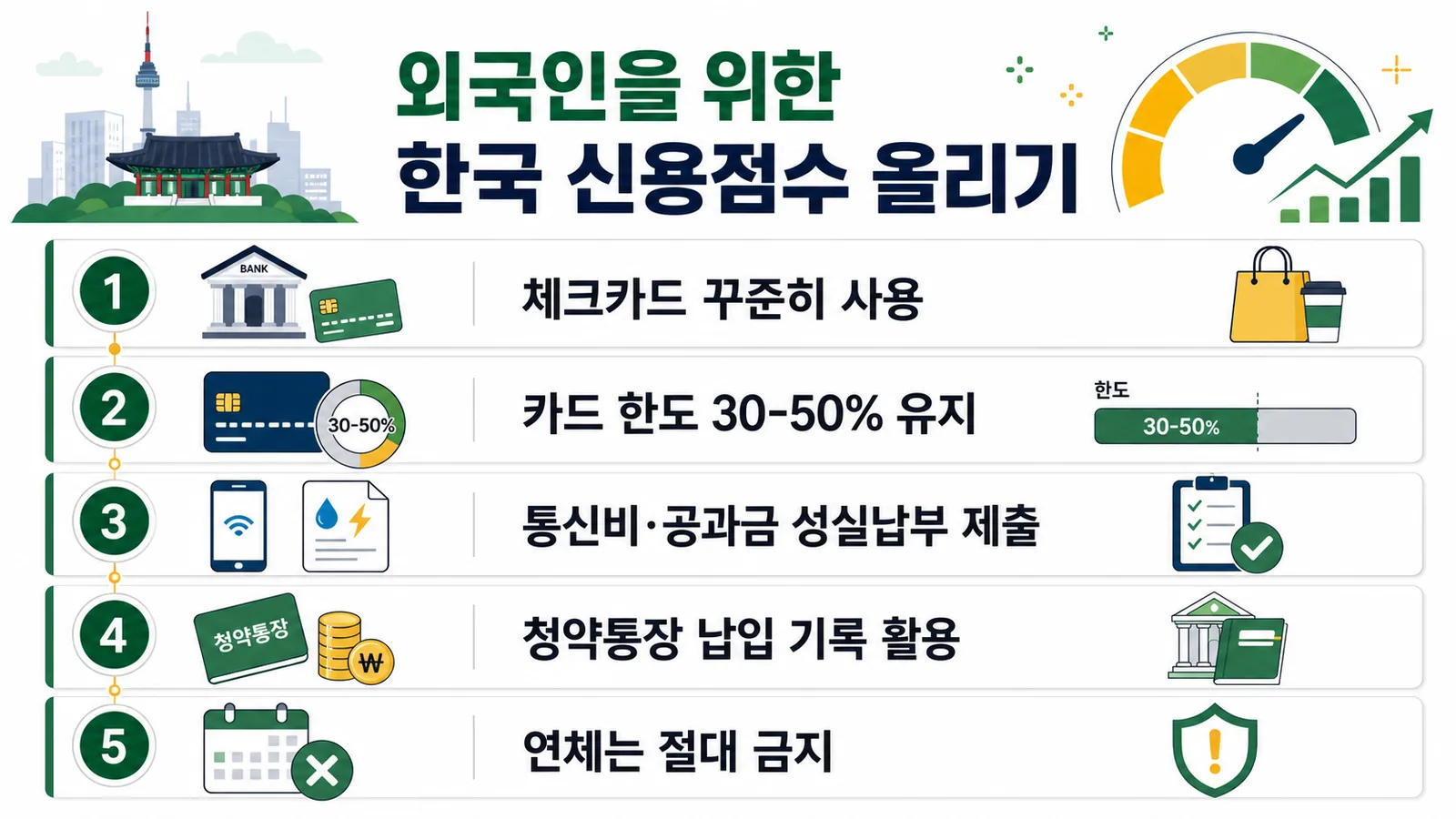
Summary and More Related Posts
The shortcut to obtaining a high credit score as a foreigner in Korea is 'Sincere and consistent financial transactions' and 'Zero overdue payments'. Check your credit score on your smartphone app today, and submit your health insurance or mobile bill payment history to give it a boost!
Essential Guides for Settling in Korea: